

By Mike Aylen
In a recent post on social media, I recounted a question I am often asked by retailers: “What is the easiest way to improve margin?” My answer is always the same: “Start with the margin you are losing right now that you don’t know about.”
I think it would be fair to say we have seen some volatility in the cost of goods recently, and there is more to come, so in this edition of the Inside the Margin series I am going to focus on how effective your cost and retail price maintenance is with your direct vendors. This is where retailers suffer margin erosion unintentionally due to a lack of proper pricing discipline. If you think that your business doesn’t suffer from this, I want you to ask yourself these two questions:
Have I ever run a report by a direct vendor that shows every current item and includes the column “last retail change date?”
In my business, is the only time the cost price is changed on direct vendor items at the moment of purchase order or receival?
If you have never run this report, please do so. Then sort that column oldest to newest and take a deep breath. In my work with retailers over the past 15 years, I have seen items that have had cost price changes that have not changed in retail price for up to 10 years. That is what I call giving your margin away accidentally.
If the only time your business is updating the cost price from direct vendors is when the PO or receival is processed, trust me—you will be suffering from this margin erosion. Why? Because the retail price is never adjusted 100% of the time. And that only accounts for the times when the cost price is increasing.
The other end of that is when the cost price decreases and the retail price stays the same. Sounds great, we make more margin, correct? Yes, if it keeps selling.
But this is a key reason why retailers get overpriced in certain categories. Inventory productivity falls, and in many cases, a perception is created that everything in that store is expensive. Even if your business is efficient and does adjust the cost and retail price on an item when it is ordered and received, there is often a gap in your pricing that can lead to confusion amongst your customers. If that updated item is part of a range, it will often sit in the store at a different retail price than others that need to be at the same or similar price.
So what to do? What are the best retailers doing? First, the retailers I have worked with that do this the best are utilizing their Margin Master or Pricing Planner software for much more than just setting pricing on their wholesaler items. They are building disciplined pricing rules for their main direct vendor items, as well as using it to help set discount rates for category price plans.
Using this process will not only help you grow margin but it will also eliminate the pricing errors causing poor price perception, stop the inconsistent pricing causing confusion for your customers and help you achieve a better level of freight recovery on those vendors that carry a lot of freight cost.
I look forward to bringing you the next topic in our Inside the Margin.
Improve Your Cost and Retail Price Maintenance on Direct Vendor Items
-
Clean up your inventory file. How accurate has your allocation of these items been into department, class and even fineline? How updated and accurate are the UPCs and MFR part numbers? Have this file easily accessible in Excel.
-
Ensure you are getting monthly Excel price files from your top 15-20 direct vendors and have someone in your business that uses Excel at an intermediate level who can match these two files together.
-
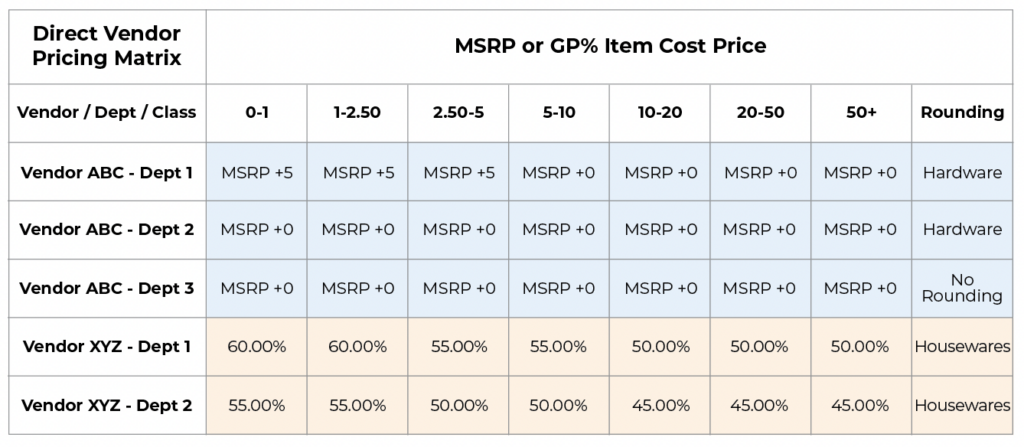
Does the vendor have a suggested retail (MSRP)? If so, am I going to follow it on everything, not just MAPP price items? If the answer to that question is yes, then the data import and update of the new replacement cost and retail price into your system is easy. If the answer to that question is no, then you should be using a pricing matrix to help set the pricing (see below).
-
Your pricing matrix will help you set the retail price using MSRP by either adding a percentage increase in certain departments or classes to the MSRP, adding a rounding plan or both. This is why accurate allocation of the items in your product file is so important. Again, this should be on items with no MAPP price only, and be careful on vendor items that you buy in a pack and split up.
-
Your pricing matrix will help you set your own margins and rounding where there is no MSRP. You will notice on the example shown that I have not set a flat margin across the board but tailored the target across the cost breaks. There are very few examples of a department or class of products where you should be setting the same margin target on all items included. This will lead to underpricing of lower priced items and overpricing of higher priced items. This costs you margin at one end and slows down sales at the other. If the cost of the item is less than $10, focus on margin percentage. If it is greater than $10, focus on margin dollars.