


While not unique to the independent channel, wage challenges can cause extra stress on small business owners already juggling tight margins. According to the U.S. Bureau of Labor Statistics, in February 2026, wages rose more than expected, increasing 0.4% for the month and 3.8% from a year ago.
When outside factors like rising wage costs, increased minimum wage, government regulations and evolving employee expectations directly impact your business, finding a balance between retaining good employees with more-than-fair wages and not bankrupting the business can be challenging.
As you develop strategies to address your own wage challenges, Jeff Grasty, president at Florida Paints, shares how he is managing payroll roadblocks through training, thoughtful benefit packages and strong company cultures.
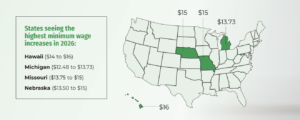
At Florida Paints, Grasty says the leadership team engages in companywide employee reviews every December and when a new employee reaches 90 days of employment. Florida Paints, which operates 27 retail locations throughout Florida, adjusts wages on a store-to-store basis because the cost of living varies greatly based on where the stores operate in Florida.
Because all employees at Florida Paints are already above the minimum wage threshold, the $1 increase in minimum wage, from $14 to $15, taking place in Florida in 2026 will not impact the operation.
“We saw a dramatic increase in entry level wages when Amazon started flooding the market with drivers and were paying far above minimum wage,” Grasty says.
To address wage challenges, Grasty says they are constantly looking at expenses, especially in light of recent economic downturns.
“While wages are usually one of the most controllable expenses, there are many other factors,” Grasty says. “We also look at number of employees per shift and making employees more efficient. We use fairly specific formulas to determine staffing levels, though that can vary based on the geography covered, customer mix and other factors. As a small company we all have to be Swiss army knives.”
Pay Isn’t the Problem: 4 Key Components of Compensation
By Curtis Gillman
Let’s talk about a universally uncomfortable topic and the words that make small business owners cringe when they hear them discussed among employees: pay rates, compensation, wages, salary and benefits. The discomfort around this topic comes from a few places. Every employee wants to be well compensated and appreciated, while many owners are conditioned to view nearly every expense as the enemy of profitability.
Payroll, often the largest controllable cost, sits squarely in the middle of that tension. Competitive wages and profitability are not opposing forces but they do force retailers to step out of their comfort zone and examine other areas of the business.
Another reason these topics strike fear in owners everywhere is that discussion of pay has historically been viewed as taboo. Many of us were raised to believe compensation was a sacred trust between employer and employee not to be discussed openly, but today’s workforce doesn’t see it that way. To compete for top talent, owners must meet employees where they are, not convince them to bend to our outdated norms. In my experience, I have found that for a compensation strategy to work, it must be: competitive, efficient, attractive and legal.
Qualifier #1: Competitive
Regardless of economic conditions, the same complaint comes up repeatedly among owners: “I can’t find good help.” When I ask about starting pay and benefits, the answer often explains the problem. Many of these businesses pay below market and offer little to no benefits, often justified by the phrase, “We just can’t afford it.”
I disagree. In reality, they can’t afford not to pay competitively. Payroll may be the largest controllable expense, but it’s really no different than other inputs: fuel, utilities or freight. You can control how efficiently you use it, but you have very little control over the rate itself. You wouldn’t only fuel up the delivery trucks when gas is cheap or turn the lights on when electricity rates drop. Wages work the same way. Think of compensation rates as largely fixed, especially in competitive labor markets. Fortunately, reliable benchmarks exist. Ask peers in your market. Network within the industry.
The North American Hardware and Paint Association’s (NHPA) annual Cost of Doing Business Study is an invaluable tool available to NHPA members that outlines payroll as a percentage of sales alongside dozens of other practical KPIs. Hardware stores typically run between 20.2% and 21.4% loaded payroll; home centers between 15.9% and 16%; LBM dealers around 14.4%; and paint stores between 24.4% and 25.4%. Where many owners get stuck is treating wage rates and total payroll as the same problem, but they aren’t. Competitive pay is dictated by the market, while payroll efficiency is a leadership responsibility. Simply put, rates are inputs, efficiency is the output and leadership connects the two.
Qualifier #2: Efficient
“Do more with less” is dangerous when misinterpreted. Cutting payroll irresponsibly in a way that hurts customer service or burns out the team isn’t the goal—improving efficiency is.
This starts with cross-training. Years ago, in less competitive markets, strict divisions of labor may have made sense, but today they rarely do. I’ve seen stores staffed three-to-one against customer traffic because only one person can cut keys, another can mix paint and one runs the register. This model drives customers away and compounds payroll problems.
Cross-training doesn’t just save labor dollars; it builds engagement and job satisfaction among employees who thrive on learning and role flexibility. Society for Human Resources Management (SHRM) data shows that skill development opportunities are a key driver of job satisfaction for both Millennials and Gen Zers. Scheduling strategy matters just as much. Schedules should be built around business needs, not habit or employee preference. One of the most common mistakes I see is mirroring schedules day to day regardless of typical customer traffic that day, or having certain days loaded while others are under-staffed to accommodate preferred days off.
Long-term team care requires short-term customer focus, and leadership means advocating for the needs of the business. Modern scheduling platforms like When I Work, Deputy and Sling make this easier than ever. These tools allow managers to input wage and benefit costs, forecast sales based on historical data and monitor labor efficiency before the week even starts, eliminating guesswork and relying on impractical and ineffective spreadsheet scheduling.
Finally, review your P&L line by line to uncover areas for practical cuts. Identifying outsourced services such as lawncare, cleaning and basic maintenance often reveal meaningful profit opportunities, and many of these tasks are often handled more effectively in-house. If your entire team is constantly busy with value-added tasks, then clearly assigning one of them to the lawnmower wouldn’t be a smart move. However if that is the case, labor efficiency may not be the cause of your profit woes and you may need to look deeper. This isn’t about blind cuts, it’s about disciplined evaluation.
Qualifier #3: Legal
Knowledge of basic employment law isn’t just about avoiding penalties; it’s an ethical responsibility. Regularly auditing compensation practices is an absolute must. When it comes to compliance, intention doesn’t matter, execution does. Factors to examine include compliance with wage and hour laws, equal pay for equal work across protected classes, minimum wage requirements and related regulations.
The National Labor Relations Act protects employees’ rights to discuss pay and benefits. Some states, such as California, take these protections even further by requiring employers to disclose salary ranges for jobs. I am not advocating that you post everyone’s pay rates on the bulletin board in the breakroom. What I am arguing is that the most effective job postings include pay ranges.
Whether or not to disclose pay ranges in job postings is a heavily debated recruiting strategy topic. That debate naturally leads to the broader and often misunderstood issue of pay transparency. According to a 2023 study by SHRM, 70% of organizations that list pay ranges report receiving more applicants and 66% say the quality of applicants has improved.
The data is clear. If you want the best and brightest, meet their expectations. If you don’t want to post pay ranges, don’t—at least until the government requires it. Pay transparency can create headaches and hurt feelings without the right guardrails in place. Thankfully, there are proven, actionable ways to manage this effectively. Knowing that employees are likely to learn what their coworkers earn, the best approach is to establish clear, documented pay scales with defined paths for advancement, paths that benefit both the team member and the organization. Be intentional and creative.
Identify your operational challenges and reward the employees who help solve them. If cross-training is a weakness, tie compensation increases or bonuses to mastering defined skills. If performance is the issue, clearly document expectations, provide regular feedback and connect improvement to raises during evaluations. Team members shouldn’t be surprised by what they hear at review time, and if you manage in the moment and document both wins and challenges, they won’t be.
Qualifier #4: Attractive
When competing with high-paying employers, don’t overlook the value of benefits others may not offer. Many small employers assume health insurance or retirement plans are out of reach, but before dismissing them, do yourself and your team a favor. Talk with a qualified broker. Employer-paid health insurance premiums are typically tax-deductible and not subject to payroll taxes, meaning those dollars often go further than wage increases alone.
Retirement plans can also be surprisingly affordable and can be implemented with no match or a modest, tax-deductible contribution. Beyond the financial impact, offering these benefits signals stability, professionalism and long-term commitment, and it helps your job postings stand out in a crowded market.
Performance-based bonuses can also be powerful tools when structured correctly. Sharing a small percentage of gross profit improvement or rewarding training milestones aligns employee success with business performance. This isn’t comfortable work. But retailers who win the talent battle also win the profitability battle, and they won’t be the ones that pay the least. They will be the ones who are clearest, fairest and most intentional.
The call to action is simple: stop running your store the way it was run a generation ago. This isn’t your grandfather’s hardware store. However, one timeless principle will always apply: take care of your people and they will take care of your business.
 Meet Curtis
Curtis is a retail consultant and owner-operator with over 20 years of experience in the independent hardware and home improvement channel. He is the founder of Legacy Retail Advisors, where he works with independent retailers to improve operational performance, strengthen teams, and plan for succession. His approach focuses on disciplined execution, KPI-driven management and intentional leadership development.