


From toothbrushes to tortillas, cat food to couches, with a few swipes and taps, a consumer can have nearly anything they want or need delivered to their front door, sometimes within hours.
No longer just a buzzword, omnichannel is the expectation when it comes to a customer’s shopping experience. Consumers want it all: the ability to shop online that blends seamlessly with a meaningful in-store experience, all wrapped up with convenient last-mile solutions.
And as e-commerce continues to grow, Forrester’s U.S. Retail E-Commerce Forecast, 2025 to 2030, predicts that U.S. e-commerce sales will hit $1.8 trillion by 2030 and will account for 29% of total retail sales—the need for last-mile solutions like delivery will also grow. 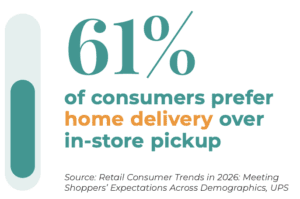
Sharing the Road
Partnering With 3rd Party Last-Mile Companies
If a retailer would like to get into delivery but doesn’t have the manpower or operational infrastructure to support it, numerous third-party companies exist that partner with retailers to offer delivery services.
Because the delivery radius for Warehouse Paint covers a large area—the stores regularly make deliveries to jobsites that are two to three hours away in the San Francisco Bay Area and Central Valley—president Leslie Kilmer says they have looked into using a third-party to help with deliveries.
“Logistically, it doesn’t currently make sense for us because we prefer to maintain our own scheduling control and quality standards, but options definitely exist and may be better suited for retailers without their own fleet,” Kilmer says.
Some of the options available to retailers include Roadie, which offers same-day delivery and delivery for larger, bulkier items, and GoShare, which provides both local and long-distance delivery options.
Within the industry, Lowe’s and The Home Depot both partner with DoorDash and The Home Depot also offers delivery through Uber Eats and Instacart. In the independent channel, Ace Hardware partners with DoorDash, Uber Eats and Instacart and RONA in Canada utilizes DoorDash.
Meeting customers where they are, whether that is at home, in the store or online, is vital to a retailer’s success, and for independent paint and decorating retailers, any chance to differentiate themselves and gain some market share is welcome for growth. Learn how two retailers are meeting their customers’ expectations with delivery services and how it has helped differentiate their businesses in their local markets and provide an additional layer of customer service for both pros and DIYers.
Set Apart by Service
Providing paint, coatings and interior design services to Northern California since the 1950s, Warehouse Paint, which now has five locations in the Sacramento area, has offered delivery since the 1970s. Leslie Kilmer, president for Warehouse Paint, says delivery has been a crucial part of the company’s operations for at least five decades.
“Even as we’ve opened up new stores, delivery has always been a core part of our services,” Kilmer says. “It’s allowed us to expand our reach and support customers from centralized store locations.”
Each of the operation’s five stores has the equivalent of a full-time driver, with some stores having employees who split their time in that role, so other employees do not have to figure out how to divide time between serving in-store customers and making deliveries.
Each store also has one or more delivery vehicles, either a van, truck or both. All deliveries come directly from each store. Warehouse Paint does not operate a centralized warehouse and each location’s manager has the autonomy to manage delivery in a way that best suits that store. While the majority of deliveries are 5-gallon buckets of paint, Warehouse Paint will deliver pretty much anything for sale in the stores, while always staying conscious of the high gas prices in California, Kilmer says.
“While we don’t necessarily have an order minimum or specific turnaround time for deliveries, we certainly try to make every request work with the rest of our delivery schedule,” she says. “If it’s a contractor who is truly short just a gallon, we’re going to work that in as quickly as possible to meet their deadline. If it’s a customer that’s always having us deliver a single gallon the same day, we’ll have a conversation to find a better way to serve them and protect our bottom line. Serving customers is the primary goal so if a store is unable to get product delivered to meet their deadline, we have other resources such as our outside sales team to help make it happen.”
Offering delivery services comes with upfront equipment costs, additional labor costs, maintenance and effort, but for Warehouse Paint, this service has helped differentiate them in the market. Kilmer says other retailers considering adding delivery services should be certain they are in the position to be able to off er the service fully.
“To be able to do delivery right, you have to go all in and truly embrace the service, including all that comes with it—those upfront costs for a vehicle and personnel, maintenance costs and more,” Kilmer says. “Offering delivery provides tremendous value to our customers and is a core part of our services. I can’t imagine us not doing it.”
Edging Out the Competition
Delivery services have only been a part of the offerings at Andriots Paint & Flooring in Shelbyville, Kentucky, for about five years, but they make a big impact in the level of service the store offers. BJ Andriot, owner of Andriots Paint & Flooring, says he added delivery at the same time he added an outside sales rep, which also coincided with the COVID-19 pandemic.
Expectations Make a U-Turn
In early 2026, Roadie, a UPS company, and Supply Chain Dive’s studioID conducted a survey of 1,000 consumers who had purchased goods online in the past six months, which revealed shifts in customer expectations when it comes to delivery. As you develop your delivery strategies, keep these consumer inputs in mind to make the experience worthwhile to your customers. 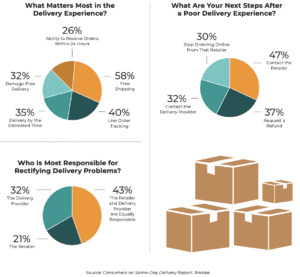
“When COVID-19 happened, delivery provided us a way to get paint to people’s houses when they didn’t want to leave,” Andriot says. “Between delivery and curbside pick-up, we did everything we could to keep business going.”
Most of the deliveries are done by a sales rep who receives the orders from customers and then shares them with the store to fulfill. Currently, it is mostly the store’s pro and contractor customers who are taking advantage of delivery services, but Andriot says they do have a handful of retail customers who use it too, including several elderly painters and a local woman who paints statues. The store also sells flooring and delivers to those customers two to three times a week on average.
“Delivery definitely takes some manpower, but it’s worth it,” Andriot says. “There are a lot of places that don’t deliver, so it gives us an edge against other stores and big boxes in the area.”
Andriots Paint & Flooring doesn’t have a delivery minimum and will even deliver as far as Louisville or Cincinnati, several hours away. There is no delivery fee for paint and sundries, although sometimes Andriot will charge a fee to deliver larger flooring orders. For Andriots Paint & Flooring, finding delivery success has meant getting the word out and setting reasonable expectations with customers.
“I have had customers call and want delivery in 15 minutes of them placing the order, so I’ve had to ‘train’ them to think more ahead and not wait until the last minute to place paint orders for delivery,” Andriot says.
In the last five years, Andriot has also seen how delivery has increased customer counts.
“Because we offer delivery, I’ve had customers order from me who wouldn’t normally come into the store because they are too far away from our small town,” Andriot says. “Delivery does get that additional business and expands our reach.”